Track the swarm.
Find the invisible.
FalconEye is the AI brain for counter-swarm defense — tracking whole drone swarms in real time and detecting the RF-silent autonomous drones that every existing CUAS system misses. The SDK, not the system.
The brain, not the box.
We don't build the system. We build the one software layer that's underbuilt and rising in value — the intelligence that sits above any sensor and below any kill chain — and license it to the people who own the rest.
Three hard problems. One SDK.
FalconEye solves the three layers of the counter-swarm intelligence problem that sensor-level CUAS leaves unaddressed.
GM-PHD Swarm Tracker
Gaussian Mixture Probability Hypothesis Density filter tracks whole swarms without hard assignment — no ID thrash as drones close in on each other. Birth suppression, Euclidean merge, and persistent Hungarian labelling prevent the ghost tracks that trigger false alerts.
RF-Silent Kinematic Classifier
GPS-denied autonomous drones emit no RF and ignore GPS jamming — they navigate by vision. FalconEye detects them by their kinematic fingerprint: path straightness, heading consistency, and velocity smoothness read straight off the track — no RF, no GPS correlation.
Distributed T2TF Fusion
Two geographically separated sensor nodes see the same swarm from different angles. Their error ellipses are complementary. Covariance Intersection fusion — the only mathematically consistent method for correlated estimates — merges them into a single site picture without double-counting shared history.
Sensor-agnostic above.
C2-agnostic below.
In a modern counter-drone stack, sensor hardware and command systems are mature. The middle layer — the intelligence that fuses, tracks, and classifies — is still bolt-on afterthought.
FalconEye fills that gap. A software SDK that adapts to any radar, EO, or acoustic sensor above and emits standard Cursor-on-Target tracks below. Swap a sensor; nothing above the adapter changes. Switch to a different C2; the output format doesn't move.
This is the ARM model: license the brain, own the rest.
We detect the drones nobody else can — by how they move, not what they emit.
FALCONEYE · FOUNDING THESIS
Current CUAS is built around RF: find the command link, jam the GPS, intercept the pilot. None of that works against a GPS-denied autonomous drone. It has no command link to find. It uses no GPS to jam. There is no pilot signal to cut.
The only handle left is what the drone does — how it moves. Vision-guided autonomous flight leaves a distinctive kinematic signature, and that signature is exactly what FalconEye is built to read.
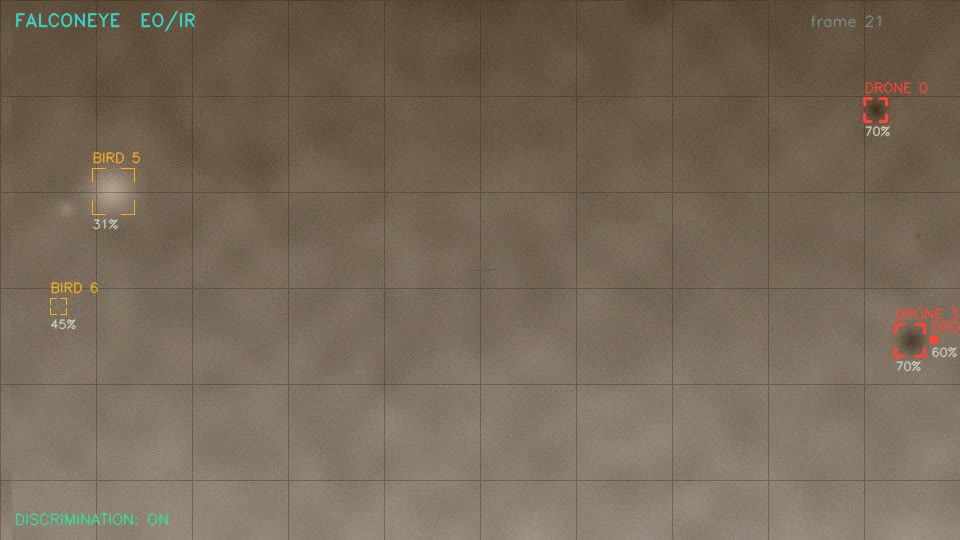
The kinematic fingerprint detector
GPS-denied drones have a characteristic flight pattern: smooth velocity with periodic correction events, high path straightness, consistent heading. FalconEye reads that fingerprint from any radar or EO track. No RF needed. No GPS correlation needed.
Real code. Real tests. No vaporware.
FalconEye is a fully shipped MVP — packaged Python SDK with a complete test suite and four live demos. All metrics are simulation-validated; real-sensor field validation is the next step.
All benchmarks simulated on synthetic data. Real-sensor field validation is the primary use of pre-seed funds.
Watch the SDK in action.
A walkthrough of FalconEye tracking a swarm, rejecting birds, and flagging the RF-silent drone by its kinematic fingerprint — running live against simulated sensor data.
Built to be licensed, not sold as a system.
FalconEye is an SDK component. You own the kill chain, the certification, and the customer relationship — we provide the swarm intelligence you'd rather not build.
Add the brain you don't have
Drop a swarm tracker and RF-silent classifier into your counter-drone platform without standing up a computer-vision or tracking team. Differentiates your hardware on the capability that's rising in demand.
Multi-sensor fusion, solved
Building a fixed-site CUAS with radar, EO, and acoustic? FalconEye's distributed T2TF layer fuses them correctly — Covariance Intersection, not naive Kalman — and emits a single coherent site picture.
A licensable intelligence core
Indigenous counter-drone capability that doesn't depend on a foreign prime owning your detection stack. Source-available licensing available for qualified sovereign partners.
Request the technical briefing.
We're in pre-launch and working with a small number of design partners. Tell us who you are and we'll share performance data, the integration spec, and a path to a pilot — under NDA, with qualified partners.
We reply to qualified partners within two business days.